2025年11月29日,以"开放共建、创新发展"为主题的2025年亚洲公益论坛在海南博鳌隆重开幕,德国柏林自由大学政治与社会科学系教授、博士生导师Dr. Berthold Kuhn(康伯锐)做《非营利组织与政府关系中的治理与信任:全球动态及欧洲挑战》主旨发言。
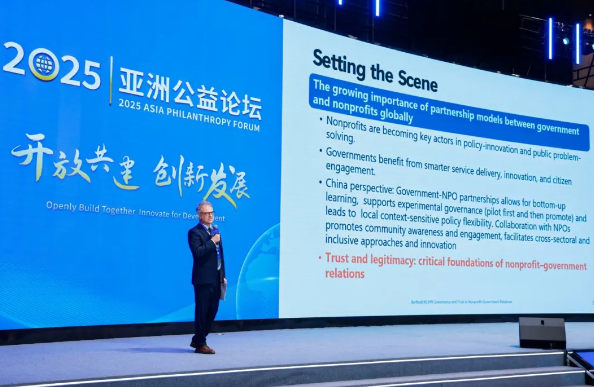
在2025年“亚洲公益论坛”上的主旨发言
女士们,先生们,亲爱的朋友们,亲爱的黄浩明教授,我非常荣幸能参加今年的亚洲公益论坛。(中文开场)
Thank you for the invitation. Ladies and gentlemen,
感谢邀请。女士们、先生们:
My talk today focuses on the evolving landscape of relations between NGOs and governments, businesses, and communities. We are currently at a critical stage in advancing cooperation within the Hainan Free Trade Port, which presents a significant opportunity for all parties—including governments, businesses, research institutions, and NGOs—to jointly shape a sustainable vision for the province.
我今天的发言主要聚焦在非政府组织(NGO)与政府、企业及社区关系的演变图景。当前,我们正处在海南自贸港合作推进的关键阶段,这为各方携手——包括政府、企业、研究机构及非政府组织——共同构建该省可持续未来愿景,提供了重要机遇。
NGOs are increasingly becoming key actors in the design and co-creation of policies, as well as in the implementation of social welfare programs. Government agencies also benefit from such collaborations through improved public service efficiency, innovation, and enhanced citizen engagement. One of the most important comparative advantages of NGOs is their close connection to communities. They should continually ask themselves: Do the communities we serve trust us? In fact, NGOs are building valuable bridges of trust among different stakeholders.
非政府组织正日益成为政策设计与共创过程中的关键力量,并在社会福利项目的实施中发挥着重要作用。政府部门也能从中获益,包括提升公共服务效率、推动创新、增强公民参与等。非政府组织最重要的比较优势之一,是其与社区的紧密联系。它们应当不断自问:我们所服务的社区是否信任我们?事实上,NGO正在不同利益相关方之间搭建宝贵的信任桥梁。
In China, government-NGO partnerships facilitate bottom-up learning, support experimental governance, and help adapt policies to local contexts. Such cooperation raises community awareness and participation, promotes cross-sectoral and inclusive approaches, and fosters innovation. NGOs serve as important connectors between national and local governments, citizens, and communities in areas such as information sharing, knowledge building, resource integration, service delivery, and capacity building. Their work strongly supports the achievement of Sustainable Development Goal (SDG) 17—the “partnerships” goal.
在中国,政府与NGO的合作促进了自下而上的学习,支持了实验性治理,并有助于政策在地方语境中灵活调整。这种合作提升了社区意识与参与度,推动了跨部门、包容性的方法与创新。NGO在信息共享、知识构建、资源整合、服务提供与能力建设等方面,成为连接国家与地方政府、公民与社区的重要纽带。它们的工作有力支持了可持续发展目标(SDGs)第17项——关于“伙伴关系”目标的实现。
However, we must acknowledge that the nonprofit sector also faces a series of challenges, both old and new. Scrutiny from government and business sectors is increasing, along with higher expectations. Meanwhile, economic and technological disruptions demand greater agility and accountability from NGOs. Operational complexity, regulatory pressure, rising public expectations for transparency and effectiveness, as well as economic uncertainties and political sensitivities, are all issues that must be addressed today.
然而,我们必须承认,非营利领域同样面临一系列挑战,其中既有老问题,也有新情况。来自政府与企业部门的审查日益严格,期望不断提高;同时,经济与技术变革带来颠覆性影响,要求NGO具备更强的应变能力与问责机制。运营复杂性增加、合规监管压力、公民对透明度与实效的期待上升,以及经济不确定性与政治敏感性,都是当前必须应对的课题。
In Europe, public trust in the nonprofit sector remains relatively high. The European Union recently launched a new civil society strategy aimed at better protecting NGOs from politically motivated scrutiny and providing more flexible funding. Despite this, pressures continue to grow, including financial constraints, demographic changes, and media oversight.
在欧洲,公众对非营利部门的信任度仍然较高。欧盟近期也推出了新的公民社会战略,旨在更好地保护非政府组织免受带有负面意图的政治审查,并提供更灵活的资金支持。尽管如此,压力仍在增长,包括财政约束、人口结构变化、媒体监督等。
Taking Germany as an example, the country has a strong welfare system and many successful foundations. Its NGOs are active across Asia and Africa, often in partnership with official development budgets. However, in some countries, international NGOs and donors face increasingly stringent regulatory environments and legal restrictions. Domestically, political polarization and media scrutiny have led to growing public skepticism toward NGOs. Furthermore, while the number of foundations has increased, some lack sufficient activity, becoming so-called “zombie foundations.” Therefore, the sector urgently needs generational renewal in leadership and volunteer teams, funding mechanisms adapted to changing needs, and most importantly, a balance between professionalism and voluntarism to meet the diverse expectations of governments, communities, and the public.
以德国为例,该国拥有强大的福利体系与众多成功的基金会,其非政府组织通过与政府官方发展预算合作,活跃于亚洲与非洲多地。但在部分国家,国际NGO及资助方面临愈发严峻的监管环境与法律限制。在德国国内,政治两极分化与媒体监督也导致部分公众对NGO产生疑虑。此外,许多基金会虽数量增长,但其中一些活跃度不足,成为所谓的“僵尸基金会”。因此,行业迫切需要领导层与志愿者队伍的代际更新,需要根据需求变化调整筹资机制,最关键的是,要在专业化与志愿性之间取得平衡,以应对政府、社区与公众的不同期望。
The Berlin-based Maecenata Institute, an independent think tank focused on the nonprofit sector, has developed a “performance diamond” model to assess NGOs, encompassing accountability, commitment, relevance, thematic focus, mission, and performance. Key challenges facing NGOs today include budget building and funding diversification, volunteer retention, digital adaptation, and maintaining legitimacy and trust while responding to shifting donor and public priorities. They must diversify funding sources without compromising independence, sustain volunteerism and civic energy, address capacity gaps, promote digital transformation, and link local needs with global agendas such as climate resilience.
柏林的Maecenat研究所(Maecenata Institute)作为专注于非营利领域的独立智库,提出了衡量NGO表现的“绩效钻石”模型,涵盖问责、承诺、相关性、议题聚焦、使命与绩效等关键维度。当前NGO面临的主要挑战包括:预算建设与资金来源多元化、志愿者维系、数字化适应,以及在回应捐助者与公民优先事项变化的同时,保持合法性与信任。它们需要在保持独立性的前提下拓宽资金渠道,维系志愿精神与公民活力,管理能力差距,推动数字化转型,并将地方需求与全球议程(如气候韧性)相联结。
Recent international events, such as the Global Climate Action Conference in Brazil and the Social Forum in Doha, have seen active participation by thousands of NGOs—whether UN-accredited or not—all contributing to the advancement of the Sustainable Development Goals. Importantly, we should see complementarity, maturity, and partnership rather than competition between NGOs and government agencies, as well as within the nonprofit sector itself. NGOs possess unique advantages in reaching vulnerable communities with respect and trust, promoting innovative social solutions, and mobilizing social capital and trust.
近期在巴西举行的全球气候行动大会及多哈社会论坛等国际场合,都有数以千计的NGO积极参与——无论是否具备联合国认证资格,它们都在推动可持续发展目标的进程中贡献着力量。重要的是,我们应在NGO与政府机构、非营利部门内部之间,看到互补、成熟与伙伴关系,而非竞争。NGO具有独特的优势,能够以尊重和信任深入脆弱社区,推动社会创新解决方案,动员社会资本与信任。
These major global events would not be possible without the involvement of research institutions, think tanks, and NGOs. Despite current geopolitical tensions and complex economic challenges, NGOs continue to work on the ground, facilitate perspective-sharing, and inject momentum into international cooperation. I believe that transnational collaboration will continue to flourish.
Thank you.
这些大型全球性活动离不开研究机构、智库及非政府组织的参与。尽管当前地缘政治紧张、经济问题复杂,但NGO仍持续在基层开展工作,促进视角交流,为国际合作注入动力。我相信,跨国合作将继续蓬勃发展。
谢谢大家。
来源:海南亚洲公益研究院
返回列表